Determining the ordinary-to-mirror temperature ratio of the universe
By applying the newly proposed novel ordinary-mirror neutron (n-n’) oscillation mechanism to ultra-high energy cosmic rays, we can determine the third parameter or its cosmic parameter of the new mirror model, that is the temperature ratio T’/T of the two sectors of the Universe. Here is the paper just finished on such a study: Neutron-mirror neutron oscillations for solving the puzzles of ultrahigh-energy cosmic rays.
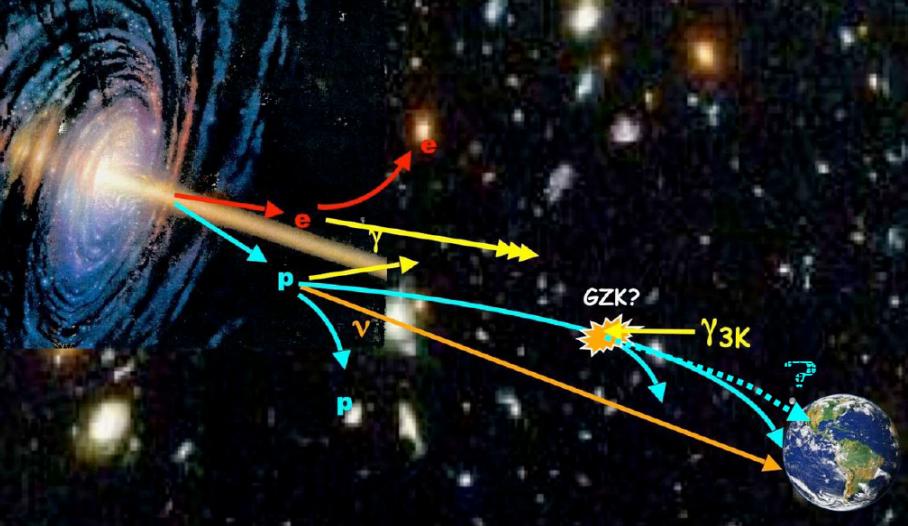
According to the new mirror matter model, both ordinary and mirror sectors have almost identical micro-physics and parameters except that the mirror world may have a much lower temperature T’ than the ordinary world temperature T. To be consistent with the results of the standard big bang nucleosynthesis (BBN) model, in particular, the well known primordial helium abundance, a strict requirement of T’/T < 1/2 at BBN temperatures has to be met to ensure a slow enough expansion of the universe. Indeed, a ratio of T’/T ∼ 0.3 can well explain the observed soft GZK cutoff of ultra-high energy cosmic rays at energies of \(\sim 6\times 10^{19}\) eV. More intriguingly, the model predicts that there exists a much sharper cutoff for cosmic rays at higher energies of \(\sim 2\times 10^{20}\) eV.


