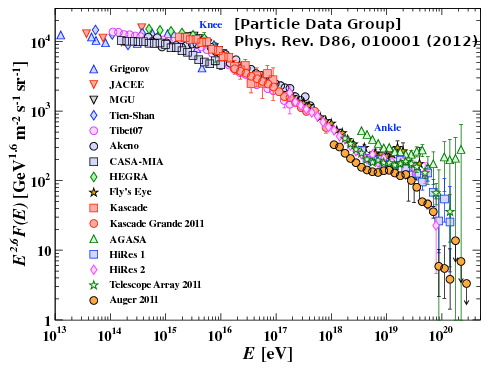
abstract: Based on a newly proposed mirror-matter model of neutron-mirror neutron (\(n-n’\)) oscillations, the puzzles related to ultrahigh-energy cosmic rays (UHECRs) are explained. In particular, the phenomena around the Greisen-Zatsepin-Kuzmin (GZK) cutoff for UHECRs can be well understood under the new mirror matter model assuming a mirror-to-ordinary temperature ratio of \(T’/T \sim 0.3\). The suppression factor of the GZK effect due to the opacity of cosmic microwave background is calculated and agrees with the observations well. Most of the super-GZK events (i.e., above the GZK cutoff), as predicted in the new model, come from mirror matter sources that are invisible to electromagnetic telescopes and can penetrate the mirror cosmic microwave background at much further distances. Most remarkably, the anti-correlation between super-GZK and sub-GZK events in the hotspot observed by the Telescope Array (TA) collaboration can be naturally understood in this model. The possible correlations between the UHECRs from the TA hotspot and other nearby powerful sources such as high energy neutrinos detected by IceCube, the largest black hole merger (GW170729) observed by LIGO, and the hottest star-forming supercluster Lynx Arc, are discussed as well under the new theory.