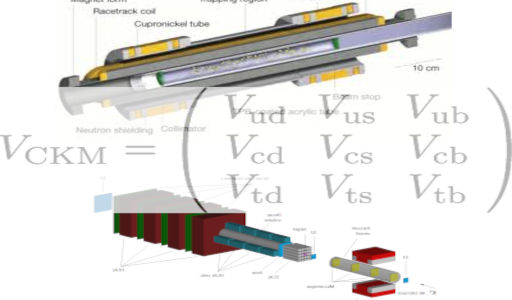
Feasible laboratory tests of the new mirror model are proposed
Several concrete feasible experiments are now proposed for laboratory tests of unique predictions from the new mirror matter model. Here is the paper: “Laboratory tests of the ordinary-mirror particle oscillations and the extended CKM matrix“.
The CKM matrix and its unitarity is analyzed by disentangling experimental information obtained from three different particle systems of neutrons, mesons, and nuclei. New physics beyond the Standard Model is supported under the new analysis. In particular, ordinary-mirror oscillations as topological transitions make up the missing strength of the CKM matrix, leading to non-unitary CKM.
Three proposed experimental programs for testing the mirror matter model stand out from various possible experimental signatures predicted. One is to measure the potentially very large neutron lifetime anomalies (easily > 100 seconds in discrepancy) using narrow or small magnetic traps. The second is to study possible resonant n-n’ oscillations under super-strong magnetic fields (B > 50-100T). The third one is to measure unexpectedly large invisible decay branching fractions of long-lived neutral hadrons such as K0.


